
|

|

|

|
CANNABACEAE - - Hops Family
|
|
|
|
|
|
Northern Hackberry (Celtis occidentalis) - Northern Hackberry or just Hackberry is a large tree to 40 m. tall. The leaves are ovate to oblong-ovate, 5-12 cm. long, tip acute to acuminate, oblique and rounded or broad-cuneate at base, margin serrate except at the base, petioles 1-1.5 cm. long. The fruit is from 7-10 mm. thick, orange-red to dark purple, on slender stalks longer than the petioles. The bark is similar to C. laevigata (Sugarberry) but usually much more prominently covered with corky (warty) growths.
Note: Botanists have recently resurrected a taxon, C. smallii, that had been submerged as a variety of C. laevigata in the past. This taxon may be what we've been calling C. occidentalis in the South or at least more common than true C. occidentalis. The Hackberry that I saw in Kansas had much larger leaves than anything I've seen in the South. So, the photos above may eventually be proven to be C. smallii.
Xeric to mesic glades, outcrops, barrens, woodlands, and bottomland forests, usually over calcareous substrates.
Habitat information from:
Weakley, Alan S., Flora of the Southern and Mid-Atlantic States, Working Draft of 21 May 2015.
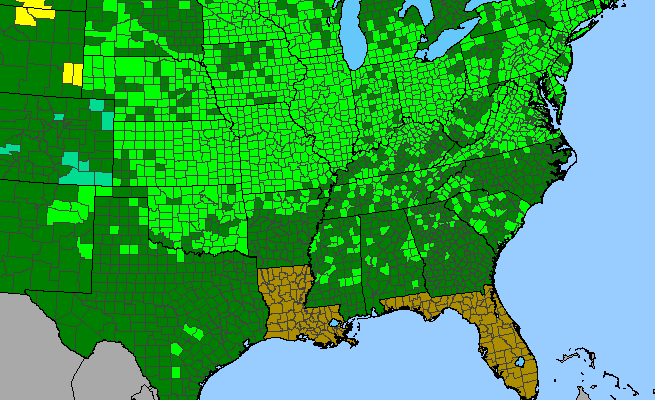
The range of Celtis occidentalis (Northern Hackberry)
Kartesz, J.T., The Biota of North America Program (BONAP). 2015. North American Plant Atlas. (http://bonap.net/napa). Chapel Hill, N.C. [maps generated from Kartesz, J.T. 2015. Floristic Synthesis of North America, Version 1.0. Biota of North America Program (BONAP). (in press)].
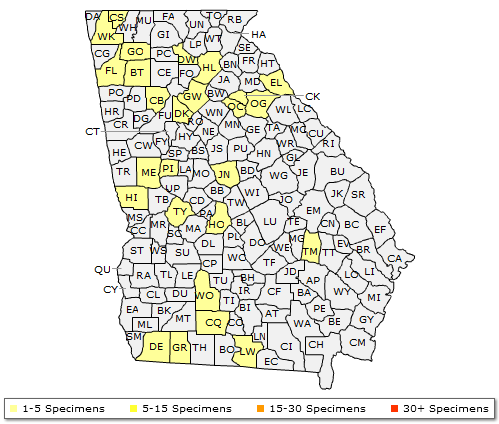
The Georgia range of Celtis occidentalis (Northern Hackberry)
Zomlefer, W.B., J.R. Carter, & D.E. Giannasi. 2014 (and ongoing). The Atlas of Georgia Plants. University of Georgia Herbarium (Athens, Georgia) and Valdosta State University Herbarium (Valdosta, Georgia). Available at: http://www.georgiaherbaria.org/.
Guide to the Trees of North Georgia and Adjacent States
Web Page © Richard Ware
send Richard an E-mail